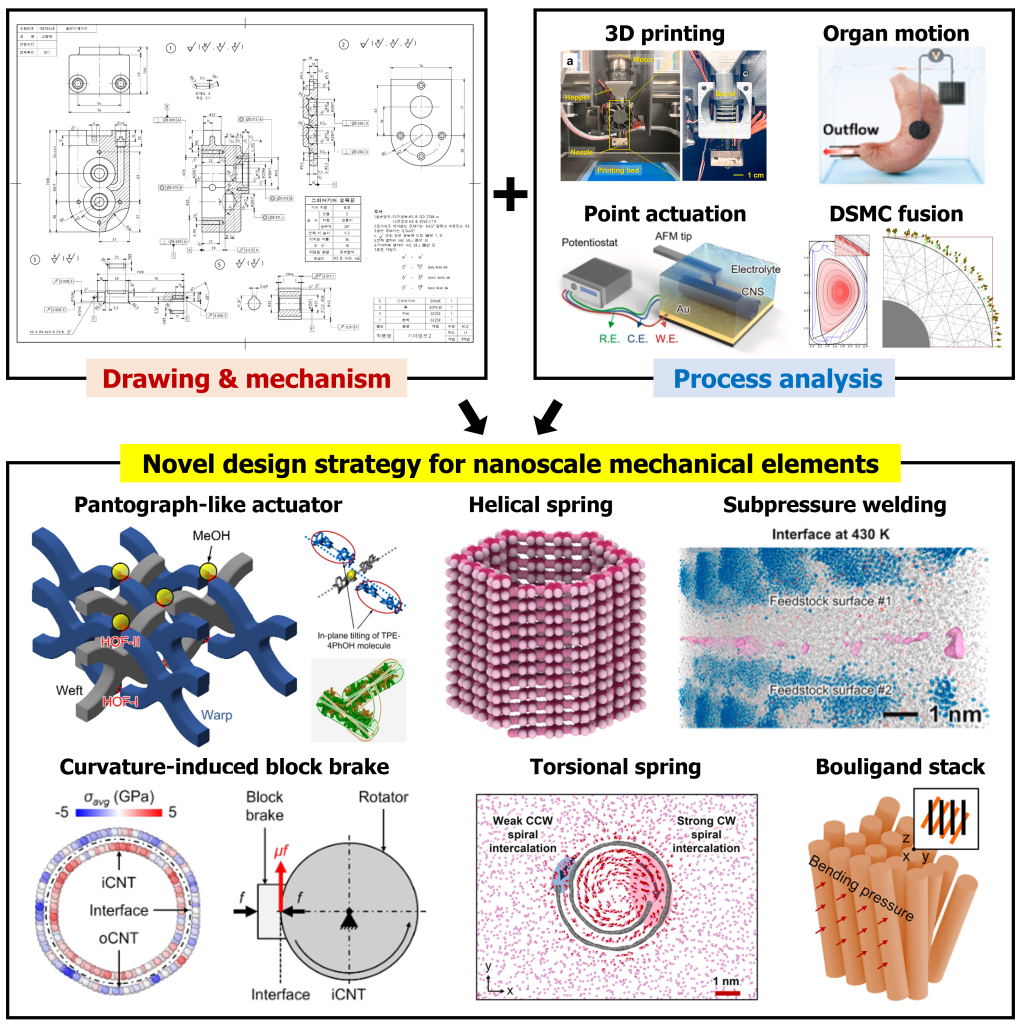
Designing mechanical elements at the nanometer scale requires precise control of material properties and structural behavior, which is challenging to achieve through experiments alone. Computational approaches, such as molecular dynamics (MD) and density functional theory (DFT), enable the study of nanoscale mechanical elements by simulating atomic interactions under various conditions. These methods help analyze properties like elasticity, fracture toughness, and energy dissipation in nanostructures, providing insights into their mechanical stability and guiding the development of nanodevices with optimized performance.
Nanomechanical element design benefits from computational techniques in applications like nanoscale actuators, bearings, springs, and brakes. Molecular simulations allow researchers to predict friction, wear, and deformation in nanomaterials, aiding in the development of durable and efficient mechanical components. By integrating MD with finite element methods (FEM), multiscale models can capture both atomic-scale mechanisms and macroscopic behavior, ensuring accurate predictions of mechanical performance. These approaches accelerate nanomechanical system design, reducing experimental costs while enhancing reliability and functionality.
 MMDLabo.